A-Z Design Lexicon: Marcel Breuer
A-Z DESIGN LEXICON is a curated archive of the names, ideas, and works defining the design landscape.
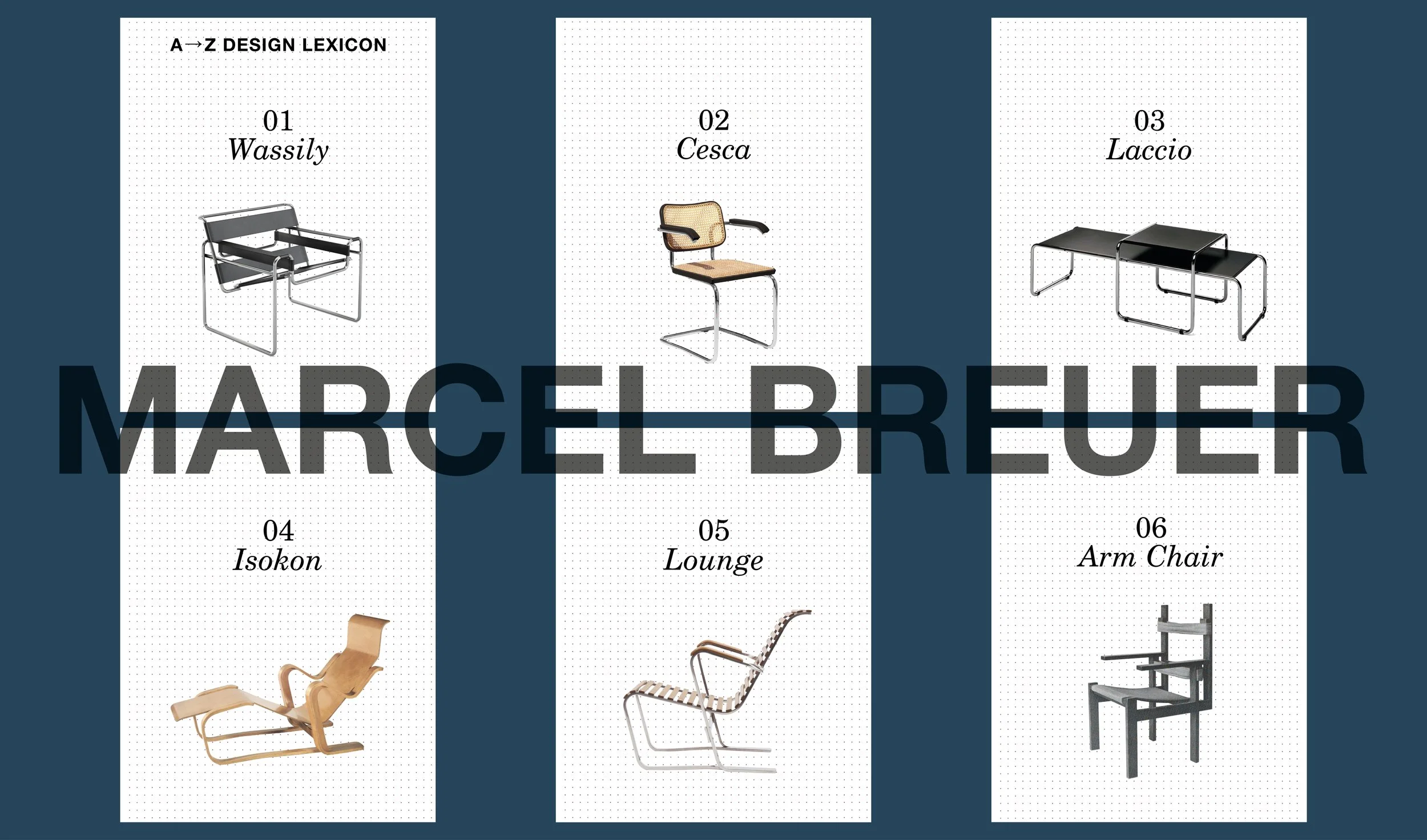
It is more through our works that we spread ideas than through ourselves.
Marcel Breuer (1902–1981) stands as one of the key figures of modernism. He moved effortlessly between furniture and architecture, questioning one central idea: weight, both physical and visual. He focused on ways to make structures appear lighter than they are, to reduce mass to a line, and to negotiate gravity rather than deny it.
His early Armchair (1922), made while he was at the Bauhaus, shows this exact interest. Inspired by Gerrit Rietveld and De Stijl’s abstract style, the chair looks like a three-dimensional drawing. Its planes and lines cross with clear intention, showing how it is built instead of hiding it. The design is experimental, structural, and thoughtful.
This idea led to a breakthrough with the Wassily Chair (Model B3, 1925). Inspired by bicycle handlebars and created at the Bauhaus, the chair swapped heavy upholstery for a metal frame and stretched fabric. When it was later produced for the public, it became a symbol of modern design. The structure itself became the “look” of the chair. The frame was no longer hidden; it was the main feature.
The Cesca Chair (Model B32, 1928) took that bold idea and made it more accessible. By bringing the cantilever design into homes, it mixed tubular steel with wood and cane. Unlike the experimental Wassily, the Cesca became popular in Europe and the United States. Today, it is one of the most well-known chairs of the twentieth century, balancing machine-made precision with a warm, natural feel.
The Laccio Tables (1925) show how Breuer used tubular steel in new ways, this time in a horizontal direction. Their thin steel frames and flat surfaces seem stretched, almost like small architectural roofs. There are no extra decorations; everything is about lines and flow. The tables are a good example of structural minimalism—light, precise, and almost diagrammatic.
Breuer’s entrepreneurial and material explorations continued with the Aluminum Lounge Chair (1933–34) and the Easy Corner Chair (mid-1930s). In these works, he pushed his investigation further: how could one material resolve the entire construction? Steel and aluminum were not stylistic gestures but structural commitments. Later, his embrace of plywood marked another phase of experimentation — bending, laminating, and rediscovering form through the material's internal logic.
Breuer’s work is interesting because his furniture and architecture are so different. His chairs and tables seem almost weightless, like sketches in space. In contrast, his buildings, such as the former Whitney Museum of American Art in New York and large concrete projects in Europe and the United States, are bold and heavy. While his furniture explores lightness, his architecture faces gravity head-on.
No matter the scale, Breuer’s main idea stayed the same: form comes from structure, and structure supports life. He saw furniture and architecture as equally important. To him, a chair was like a small building, and a building was like a larger object. Both expressions voiced the same modernist conviction.