A-Z Design Lexicon: Franco Albini
A-Z DESIGN LEXICON is a curated archive of the names, ideas, and works defining the design landscape.
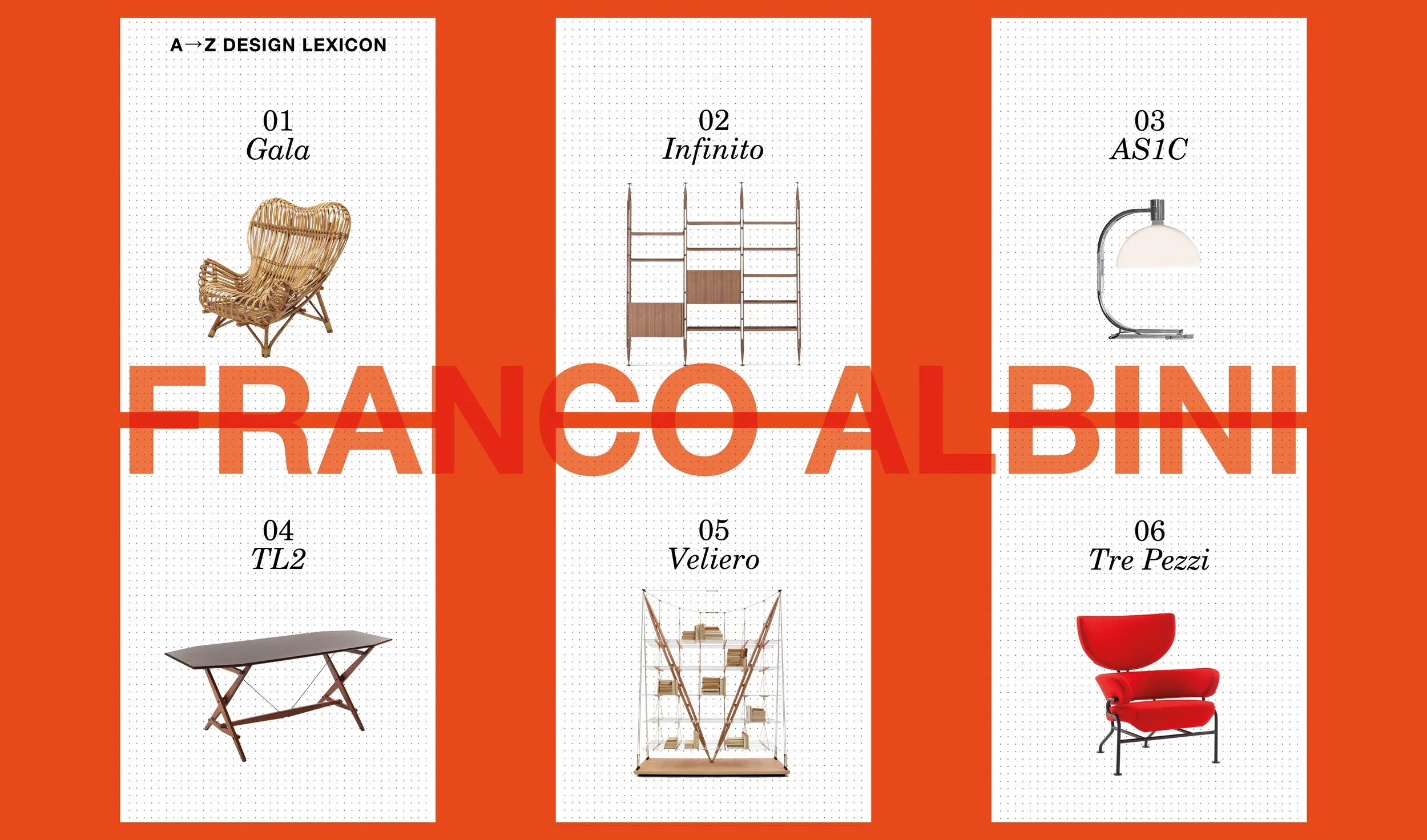
It is more through our works that we spread ideas than through ourselves.
Franco Albini (1905–1977) stands as one of the most rigorous and intellectually grounded figures of Italian modernism. Trained as an architect at the Politecnico di Milano, Albini developed his practice in close dialogue with the principles of Rationalism, while maintaining a deeply human and ethical approach to design. Throughout his career, he worked across architecture, interiors, furniture, exhibition design, and industrial objects, always guided by a belief that form must arise directly from structure and function.
Albini’s work emerged in a critical moment for Italian design, when the discipline was negotiating between tradition and industrial modernity. Rather than choosing sides, he built a bridge between craftsmanship and engineering. He collaborated with leading manufacturers such as Cassina, Brionvega, and later Arteluce, while also designing museums and exhibitions that reshaped how objects were displayed and understood. His legacy lies not in stylistic gestures, but in method: a disciplined reduction of form, an insistence on clarity, and a refusal of decoration as an end in itself.
A defining characteristic of Albini’s design language is the exposure of structure. He believed that construction should never be hidden; instead, it should become the visual and conceptual core of the object. This philosophy is often referred to as Albini’s “code”: clarity of structure, honesty of materials, and precision of detail. Wood, glass, metal, leather, and rope were treated not as surfaces, but as active structural elements. Nothing was added unless it was necessary, and every joint carried meaning and purpose.
The selected works—Gala, Infiniti, Veliero, TL2, AS1C, and Tre Pezzi—exemplify these principles with exceptional clarity. The Gala chair expresses restraint and balance through refined bamboo construction, where proportions and joinery define its elegance. Infiniti explores lightness, reducing staging to its essential elements without sacrificing stability. The iconic Veliero bookcase, inspired by nautical engineering, makes tension, gravity, and balance visible through delicate metal frames and slender uprights, turning mechanics into poetry.
Lighting designs such as AS1C and TL2 reveal Albini’s technical intelligence. Here, illumination is not decorative but architectural—light is directed, controlled, and stripped of excess form. The Tre Pezzi armchair further demonstrates his modular thinking: three distinct upholstered elements combine to create both comfort and compositional clarity, anticipating later ideas of flexible, system-based design.
Franco Albini remains historically significant not because his work seeks attention, but because it withstands it. His designs teach us that good design does not rely on trends or ornament. It relies on logic, precision, and respect—for materials, for users, and for time. In Albini’s work, clarity is not an aesthetic choice; it is a moral one.