A-Z Design Lexicon: Achille Castiglioni
A-Z DESIGN LEXICON is a curated archive of the names, ideas, and works defining the design landscape.
It is more through our works that we spread ideas than through ourselves.
There is a particular kind of designer who does not begin with form. Achille Castiglioni began with attention — a sustained, almost anthropological gaze directed at the objects and gestures that compose everyday life. Where others sought to invent, he preferred to observe. The result was a body of work that is simultaneously familiar and startling, rooted in the recognizable yet arriving somewhere entirely unexpected.
Born in Milan in 1918, Castiglioni collaborated for years with his brothers Livio and Pier Giacomo before carving an unmistakably individual trajectory. His studio on Piazza Castello became a kind of laboratory for interrogating the self-evident. He collected objects the way a philosopher collects arguments — not for display, but for thinking through.
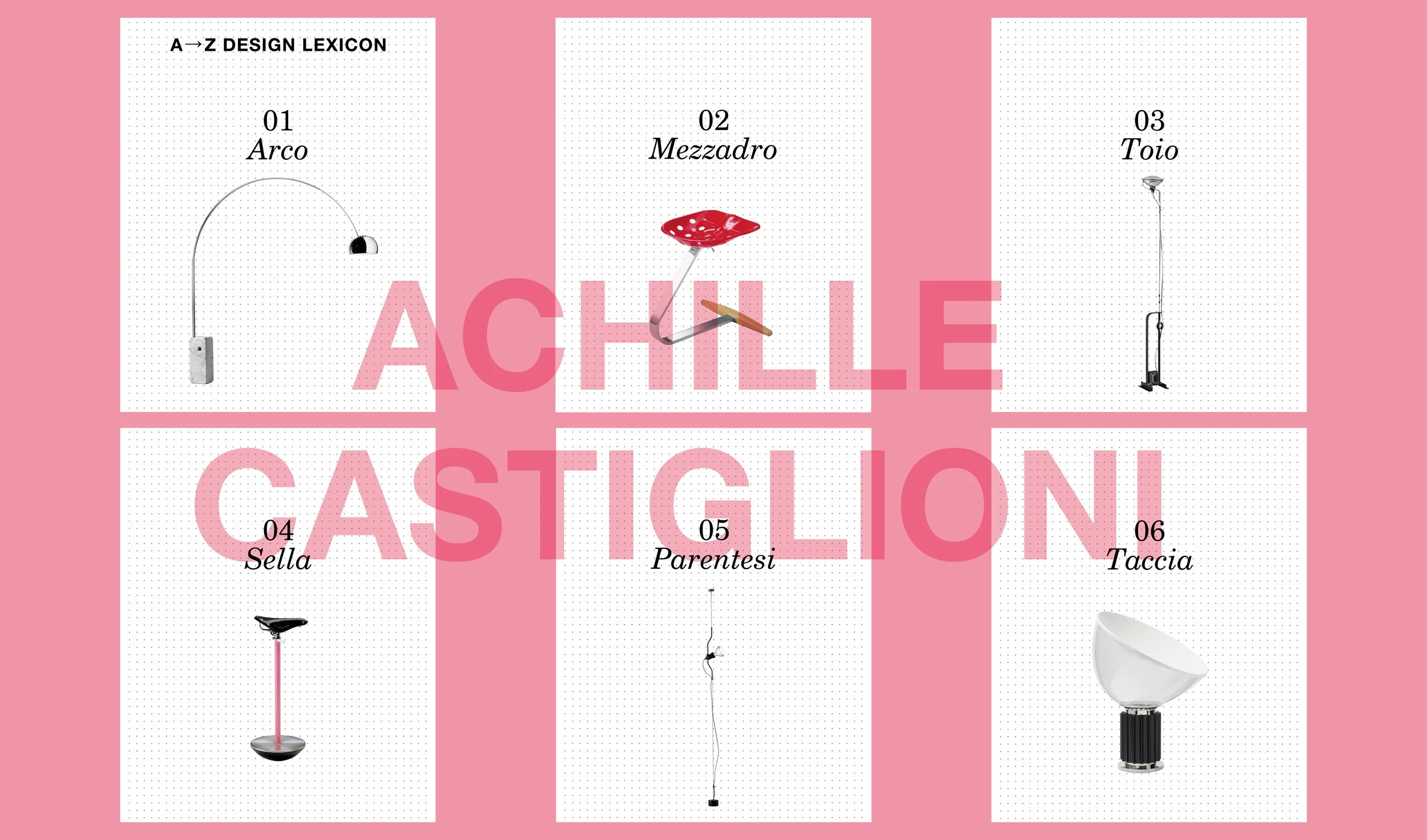
The Arco floor lamp (1962, Flos) is perhaps his most iconic gesture. A slab of Carrara marble anchors a sweeping stainless steel arc that carries a lamp over a dining table — without drilling into the ceiling, without the clutter of a pendant fitting. It solves a real domestic problem through an almost theatrical proposition. The marble counterweight is so deliberately heavy that Castiglioni drilled a hole through it, so you could thread a broomstick in and carry it between two people. The mundane and the monumental coexist without apology.
The Mezzadro stool (1957, Zanotta) takes this logic further — or rather, it takes a tractor seat and mounts it on a steel stem with a wooden crossbar footrest. Ready-made in spirit, Castiglioni was making this gesture before it had a name in design discourse. The object asks you to question what a stool is, and whether agricultural ergonomics might outperform anything conceived from scratch.
Toio (1962, Flos) performs a similar sleight of hand. A car headlamp — standard, industrial, purchasable at any auto parts shop — is mounted on a telescoping rod, itself plugged into a transformer disguised as a counterweight. It is a lamp assembled from confessions: every component announces its origin. Nothing pretends.
The Sella stool (1957, Zanotta) revisits the bicycle seat with the same affectionate detachment. Mounted on a single curved metal rod with a rounded base, it invites a posture halfway between sitting and standing — a telephone stool for an era when calls demanded restless hovering. The object knows how you will behave in it.
With Parentesi (1971, Flos), co-designed with Pio Manzù, a tensioned steel cable runs floor to ceiling, and a lamp slides up and down it, held by friction alone. It makes lighting adjustable without mechanism, positional without permanence. It describes a domestic architecture of the provisional.
Finally, the Taccia table lamp (1962, Flos) operates through inversion. The light source faces downward into a wide glass bowl, which reflects it back upward and outward — a lamp that illuminates by looking away from you. It is generous precisely because it refuses the direct.
Castiglioni's work does not ask to be admired so much as understood. Each piece carries a small argument about how we inhabit space, how the body navigates objects, how function can be both rigorous and comic. He remains proof that design's most fertile territory lies not in the future, but in the present — examined, without blinking, with curiosity and a readiness to be surprised.